Testing
The suite went red on Friday’s release. See which tests, since when, and on which build.
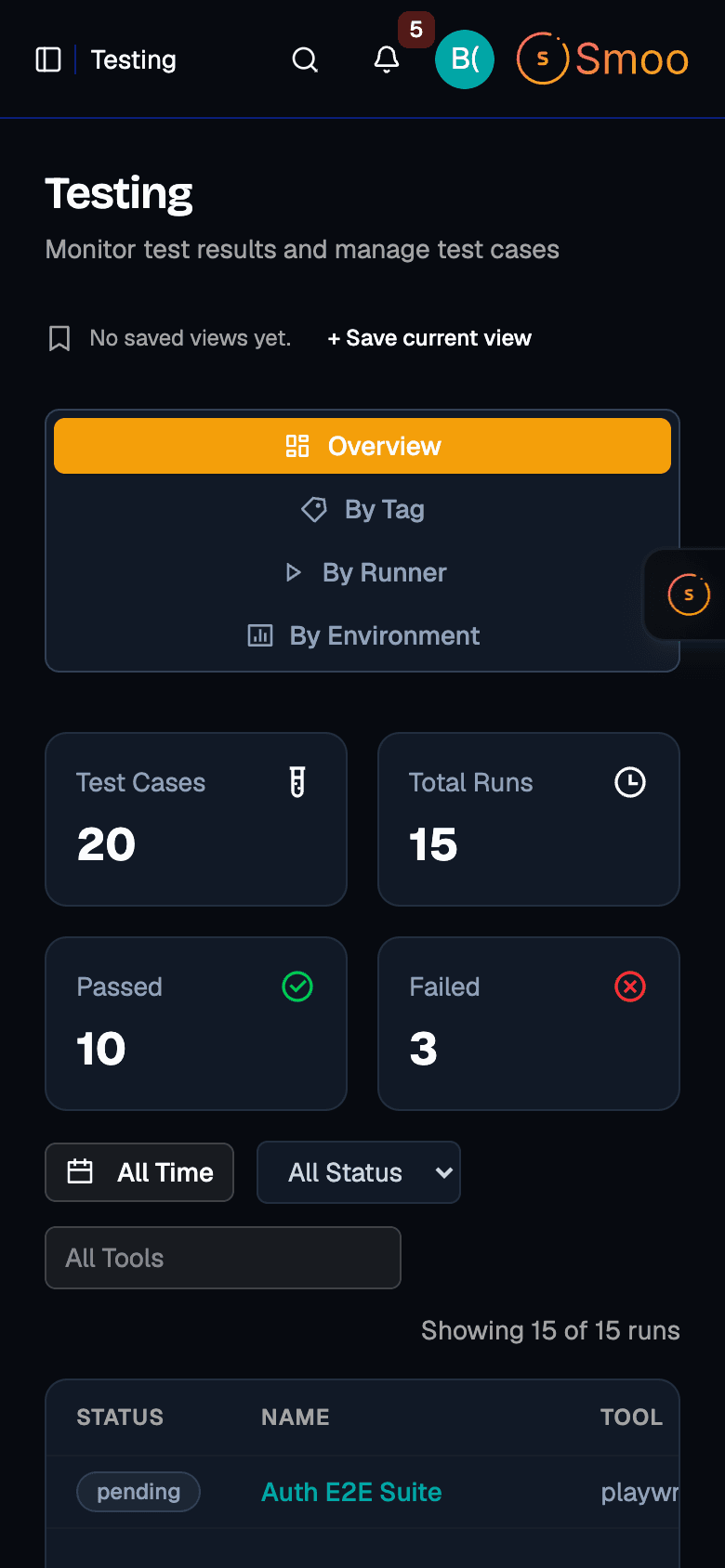
Send the report your test runner already writes and every run lands in one place, tied to the environment and deployment it ran against. The failure lines up with the release that caused it.
- Any runner that writes CTRF
- One CLI step in CI
- Every run tied to a release
Add one line to your pipeline. Get the failures by name.
Your runner writes the report. One command sends it, tagged with where it ran and what it tested.
Every run, kept and sorted. Filter by runner, tag, or environment.


How results get in
- Runners
- Playwright, Vitest, Jest, Mocha, pytest, and anything else with a CTRF reporter
- CLI
- smoo api testing runs report, from a laptop or a CI step
- SDK
- @smooai/testing for TypeScript, when you’d rather report from code
- GitHub
- Deployments and environments sync in, so runs group by release
It keeps the record. You make the call.
It reads your runner’s report, not a guess at it.
Results come from the CTRF file your runner already writes: every test, its status, its duration, its error, and its stack trace.
Retries and flakes stay visible.
Each result keeps its retry count and your runner’s flaky mark, so a test that only passed on its second try doesn’t pass as clean.
Every run points at a release.
Tag a run with its environment and deployment and the failure lines up with the build that caused it.
Your results stay in your organization.
Runs, cases, and deployments are scoped to your organization, and CI reports with its own machine credentials.
Nothing re-runs on its own.
Smoo records and shows. Whether to roll back, re-run, or fix forward stays your call.
- Every result comes from your runner.
- Retries stay on the record.
- Every run points at a release.
Fair questions
The questions people ask first. Straight answers.
Will this replace my team?
No. It takes away the scrolling through CI logs to find which test broke on which build. Your engineers still read the failure and decide the fix; they just start from the right test.
Which test runners work?
Anything that writes CTRF, the Common Test Report Format: Playwright, Vitest, Jest, Mocha, pytest, and more. If your runner has a CTRF reporter, it works.
How do results get in?
One CLI command in your CI step, smoo api testing runs report, or the @smooai/testing SDK from code. CI signs in with machine credentials, not a person’s login.
Can I ask Smooth Operator about my test runs?
Not yet. Smooth Operator doesn’t have testing tools today, so the runs page and the CLI are how you read results. We’d rather say that than show you a conversation it can’t have.
What does it cost?
Testing is $29/mo on top of any AI plan, or part of the Platform Bundle.
How is this different from the test tab in my CI?
Your CI shows one run at a time and forgets it. Here every run is kept, tied to its environment and deployment, next to the rest of your business on Smoo. ChatGPT helps you think. Smooth Operator does the work, inside your business.
Next Friday the suite goes red, know which build did it before standup.
Testing is $29/mo on top of any AI plan. Add one step to CI and your next run is in.